The Proof You Need to Believe in Jesus Christ – I
Ministries > Focus on the Family with Jim Daly

A homicide detective will describe how he investigated the life and impact of Jesus Christ across thousands of years of human history! Is there enough evidence — apart from the Bible — to prove that Jesus really was the Son of God?
John Fuller: The following program is sponsored by Focus on the Family and is made possible by the heartfelt support of listeners like you. This is John Fuller, and please remember to let us know how you're listening to these programs on a podcast, app, or website.
Jim Daly: Try to imagine this situation: you're the lead detective on a really important case, and you're looking for clues to determine who, what, where, when, and why a crime has been committed. But the challenge is, there's no evidence. Or is there? Today on Focus on the Family, we'll do an investigation about the life, death, and resurrection of Jesus Christ, who appeared in human form on this planet more than 2,000 years ago. What's the evidence for Him? What are His claims? We'll find out today. Thanks for joining us. I'm Jim Daly. I'm really excited to talk to our guest. I can remember I made that commitment to Christ at 15, and I wobbled along. Parents, be encouraged. That 15-year-old will continue to grow and develop. It was probably about 20 when I was in college, sitting in my business classes, learning about economics and advertising and marketing and all those things, and I just unplugged. I thought, "I have got to read the Bible all the way through." When you think about it, it's great to go to school. It's great to go to college. But if you haven't read the Bible, the Word, and decided for yourself, "Is Jesus real? Is He who He said He was?" you kind of miss the most important class of your life. So I want to encourage you, if you're kind of on the fence and you don't know, or you have doubts—maybe you made a commitment, it was a long time ago—dig in today because I think our guest is going to deliver some great perspectives given his background.
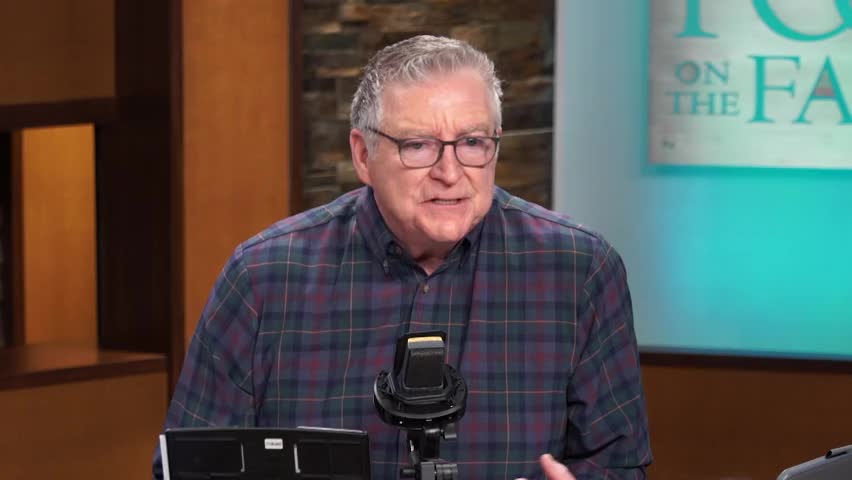
John Fuller: J. Warner Wallace has been involved in law enforcement for more than 25 years. He's a homicide detective, always focused on the facts.
Jim Daly: He described himself as an actively sarcastic skeptic about God, faith, and the Bible. I love that perspective. Again, somebody who had an honest approach to saying, "Prove it." And we're going to get to that today. It's great to have you here.
J. Warner Wallace: Well, thanks for having me. Being sarcastic and skeptical is really helpful as a homicide detective in general. If you assume upfront that everyone you're talking to is a liar, somebody will eventually go to jail. But if you assume everyone's telling you the truth, no one ever goes to jail. So I'm trying to balance what works and what's effective based on what God would call me to be. It's hard.
Jim Daly: This is totally off-topic, but given all your years in detective work, what are those things that you see about human behavior that make you scratch your head, like they really thought they'd get away with this?
J. Warner Wallace: We don't think really rationally when we think about doing things that are irrational, like killing your spouse. So a lot of times, you're driven by your emotions, and that's where we can kind of make some headway. Because sometimes we overthink it. We're thinking, "Well, look, if I was doing this, I might do these five things first," because we're thinking as though we're not in the middle of an emotional relationship that is driven by emotion. We're trying to think about it rationally and coolly. But it turns out most of the time, pretty much everything that I see in human behavior is explained really well on the pages of the New Testament. I love the fact that the Bible describes the world the way it really is. I'll sometimes be working with defense attorneys who are so convinced there's no way that their defendant could do this. I mean, they're truly convinced that the defendant could not do this because for the last 30 years—I work cold cases—this guy has been a deacon in a church, he's been a dentist, a fireman, a city council person. He's just got a regular life. Because they don't understand the enigma of man, the kind of fallen nature designed in God's image but deeply rebellious, they don't understand that dichotomy. They struggle with understanding how someone like this could do something like that.
Jim Daly: And you know what's interesting, too? So much of the culture right now is debating what's true, that there can't really be an absolute truth. But my goodness, where do you see that show up in police work? You either did it or you didn't do it, and that's absolute truth.
J. Warner Wallace: Well, and I always wonder, is this shift from objective claims about truth to subjective claims about truth eventually going to affect us in the courtroom? I've been watching court cases evolve because we're selecting jurors. I think our questions in the voir dire process are always going to cover these issues. More and more, we need to make sure that the jurors we're selecting actually understand that some things are more than a matter of opinion. Even the claim that there is no objective truth is a claim about truth that's objective. So it's self-refuting. We have to at least help and only select the jurors that understand this. Because otherwise, how would you render a decision about something that happened in the past that your opinion can't change? It either happened or it didn't happen. And that's why this is the approach I took when I first was looking at Scripture.
Jim Daly: Which is so good. Let's get some of the terminology down. Not all of us are familiar with police detective work. For example, you mentioned that you're a homicide detective, but you specialize in solving cold case no-body murders. Describe a no-body murder.
J. Warner Wallace: A no-body murder often goes cold because they are first reported as a missing person's case. This is like where a husband or a business associate—usually, though, it's a husband or a wife—who kills their spouse and then somehow effectively destroys the body and then says, "Oh, we had an argument, and they just vanished." And so you never find the body. So you don't have a body, maybe not even a murder weapon. Exactly. You don't know. And sometimes they're clever enough to wait three days, and they'll walk into a station, they can walk into the front desk. So now you're not even calling a police officer to the location; you're walking into the front counter. You're filing a missing person's report. Two days later, it's assigned to a detective. Now we're a week behind this thing. And you've had a week to clean the house, to do whatever you wanted to do, and it's basically a lot harder to solve. If you never find the body, you have the bigger challenge of, number one, demonstrating to a jury that this is a murder and not a true missing, and then number two, demonstrating that this is the guy who did the murder. So you have two things you're trying to prove, and a lot of DAs just don't want to touch these because they are difficult.
Jim Daly: And the cold case is a case that just hasn't been resolved. It could be years—10 years, 20 years. Some we're hearing in the media now where 30, 40-year-old cases are being solved with DNA and improvement.
J. Warner Wallace: Well, every crime has a statute of limitations except for murder. So if you do a robbery and a number of years go by, I can't go back and reinvestigate that because it closes by statute. But murders don't close; they stay open. My cases are like—we just did a case two years ago that was from 1972. I remember the case because my dad had the case; he was a homicide detective also. I remember I was about 10 when this 10-year-old went missing. It shook our community. My dad was kind of paranoid about it for his own kids. I remember the case. We reopened it in 2003. I think I found the DNA in 2006 or 2007. We submitted it right away, and we had no hit on the kind of predator database we have in California. Then, luckily, ancestry DNA started to emerge. It's helping to solve some problems. That's why I always thank people for searching for their family members with DNA because it eventually means I can take some of your family members to jail. Hopefully not, but it does help.
Jim Daly: Describe "person of interest." That's another term. I think I know what it means, but help us all better understand that legal term.
J. Warner Wallace: This is really something that I think emerged more after 9/11. You started to see a lot of it with the federal agencies looking at persons of interest in certain kinds of investigations. Almost always, this ends up being somebody who you suspect is your candidate for the crime, but you just don't want to necessarily put the word "suspect" on them yet. But it could also be a witness. Maybe you're looking for no leads at all yet, but we did hear that there was somebody standing over here. That's a person of interest to us; we want to be able to interview that person. So it can sometimes be a witness. But it just means that it's somebody who is another domino that's important to tip over in a series of dominoes leading to an arrest.
Jim Daly: In that regard, you used a methodology that you're trained in as a detective: "fuse and fallout." Describe that and how you applied that to this pursuit of "is Jesus who He said He was?"
J. Warner Wallace: This is kind of like timelining. We often will timeline different things to see, you know, was this guy in town when this crime occurred? You're putting things in place in a timeline. But when we're in front of juries, this is where your weird background comes into play. My dad was a detective, but I didn't think I would be a detective. I thought I would be an artist or an architect. So I got my bachelor's degree in design, and I got my master's degree in architecture at UCLA, and I was working in Santa Monica when I decided to leave that and work in my dad's profession. But when I got to doing jury trials, that visual approach to making claims kind of came back up. So I know I needed to show timelines to juries. So I just envisioned the missing on the day of the missing persons; if this is a murder, that's a bomb that exploded. He was angry; he did something he shouldn't do. But every bomb has a fuse that burns toward the explosion. And after the explosion, there was fallout everywhere all over the blast radius. What we do in front of a jury is we visualize this fuse. This is all the tension that's rising in the relationship over days, weeks, months. He's preparing to do something he shouldn't do. He's buying the stuff he's going to use to kill her or to dispose of her. This is the stuff you do before a crime. Then the day happens, and then you've got all of this activity afterwards. This is the blast radius, the fallout that kind of gives you away because people don't do this. You're destroying your wife's property like you think she's never coming back. Well, what if she's just run off? Why would you destroy her property unless you know she's not coming back? So you kind of do things that tip the hat. That's what we're doing here in front of a jury; it's fuse and fallout. So what I've envisioned here is if there was no New Testament, no evidence in a crime scene—if I don't trust anything the New Testament tells me about Jesus—is there enough evidence in the fuse and fallout of history to show me what happened in the first century, even if I had nothing from the crime scene, if I had nothing from the New Testament? Now, of course, I think that all the information about Jesus has to come from the New Testament, but I'm just taking an approach that should reflect what's in the New Testament if Jesus is who He said He was.
Jim Daly: Let me ask this question because some are probably thinking it. Why did you even come up with this idea? I mean, what was happening that you said, "Ah, I wonder if I apply my detective skills to something that happened 2,000 years ago, if it would work?" What was the motivation?
J. Warner Wallace: We got to this church. My wife thought, "Well, we've got kids now, and they're five and seven. Should we raise them in the church?" I thought, "No. I mean, I wasn't raised in the church, and I turned out pretty well." Of course, we always think that, right? Oh yeah, I'm going to say that for sure. But I didn't really have a desire. But I love my wife, and if you want to raise kids in the church—and she was kind of a cultural Catholic growing up. We didn't own a Bible, and she'd never read a Bible, never read a New Testament. We didn't understand what the gospel was; that wasn't part of our life. We never really heard it said that way. But we go to this church—she nagged me about it for about three years. Good for her. Actually, Susie is the reason. God has used Susie in my life in a way I can't even explain. So without her, I'd be nowhere. She convinced me to go. So I sat in church, and the pastor said that Jesus was—he said a lot of things, but the thing that stuck with me, because I wasn't really interested in any of the other things, he said that Jesus was the smartest man who ever lived. So I thought, "Well, what's so smart about Him?" So I did buy a Bible; I bought a Pew Bible. I just wanted to read what Jesus had to say, not really expecting it to be more like Proverbs, just like wisdom statements, not so much a narrative about from people who want me to believe that this sequence of events occurred in this order, occurred in this location at some point in history. What is this? This is like supplemental reports in a cold case. I mean, I don't have access in cold cases. I don't have access to the witnesses anymore; they're dead. I don't often have access to the report writers because those detectives are passed away. I had a case from 1972 where everyone was dead before I got there. When we actually solved that case, our suspect had been dead for 15 years. So this is an old case. So the question then becomes, well, how do you manage these cases? How do you investigate these old cases?
Jim Daly: So apply that, you know, the fuse and fallout, for example. Apply what you learned in detective work to Jesus. How did you apply that?
J. Warner Wallace: I thought, "Okay, I'm going to do both an inside-out and an outside-in approach." I did an inside-out approach: "How do we know that the Gospels are telling us something reliable?" I've written about that in a book called *Cold-Case Christianity*. That really is just to apply the template for reliable eyewitnesses that we offer to jurors and applying that to the Gospel authors. That showed me a lot. But I also thought, "Well look, if Jesus is who you all think He is, are you really telling me that the only people who noticed this are four writers in the first century? Wouldn't you expect that if He's the rock you think He is, when you throw Him into the pond, there'd be some ripples, wouldn't there? I mean, I should be able to see this in the fallout of history." But having never been taught that, really, I didn't know what the impact of Jesus was in history. I think this is true for a lot of young people. As a matter of fact, I think it's really important right now for us to teach our young people how important Jesus is. I think there are two questions that every young person asks now. So for every one "what" claim we make, we have to offer the two "whys." So I always say you have to give two "whys" for every "what" to Gen Z. The first "why" is, okay, so you're making this claim about Jesus. Well, why do you think that's true on the basis of what evidence? Because everyone else is going to say that their claim is grounded in science, it's grounded in evidence, and you Christians have your wishful thinking. Like, good for you, but that's not good for me. So I want to know why is this true. The second "why" is, why should I care? Even if it is true, why should I care? So I think what I really wanted to know was, does this matter? Even if this is true, does this matter? I'm ready to answer that question. I'm telling you, that's the question: why does it matter? That's a big one. I think right now, Gen Z, for a matter of fact, are less concerned about what Jeff Myers of Summit Ministries here in Manitou Springs—we had been talking about this—I think that young people are more concerned about not the "God-ness" of God—does God exist?—but the goodness of God. Does this book, this Iron Age book you folks always talk about, the source of all misogyny, racism, homophobia, transphobia—you name every phobia you can think of—is this still good? Does this matter anymore? Does anything good emerge from this? Does anything beautiful emerge from this? Well, those were the kinds of questions I had too. And so this is what the outside-in will tell you. Because if the outcome, if the impact of Jesus is evil, then why would you want to examine it? You could make claims about, say, for example, Nazism. Do I care? If it's ugly to begin with, why would I? Stop making your case; I don't care. It doesn't matter to me. But if this is something that is the source of all beauty, well, then it might matter. And one of the key things there is be cautious of what people label. It doesn't mean it's Christianity because somebody says it is; it's what's true.
John Fuller: This is Focus on the Family with Jim Daly. Our guest today is J. Warner Wallace, and boy, this is some really fascinating stuff. Get a copy of the book by our guest; it's called *Person of Interest: Why Jesus Still Matters in a World that Rejects the Bible*. We've got details about getting a copy of that book at our website. That's focusonthefamily.com/broadcast or give us a call: 800-A-FAMILY.
Jim Daly: Jim, you point out how several significant developments in ancient history allowed for the incredible dissemination of the Gospel and the exponential growth of Christianity. Start with the developments of language and writing, why that is so important at that moment.
J. Warner Wallace: A lot of the times when I'm investigating a fuse, I'm answering my own skeptical questions because I'm anticipating that the jury is probably going to have similarly skeptical questions. So when I'm examining the fuse of history that leads up to the appearance of Jesus in the first century, I'm examining really my own skepticism. I had a skepticism about a number of things, but one of them was just this question: if Jesus really is God, why wouldn't He just come now when we've got social media and iPhones and we can, you know, see? Wouldn't it be a better time to come now? Like, why does He come when He comes? But it turns out that the cultural shifts and the progress of culture and technology actually does benefit the first century in terms of disseminating information historically. So for example, you can't really—if you can't express the and articulate the detail of the Jesus story because you don't have the letters in place yet, you don't have an alphabet in place yet, if you're just using hieroglyphics to, for example, describe the Sermon on the Mount, well, good luck with that. It's not going to be easy to do. But once you have an alphabet, an alphabet that's widely distributed across the entire region, like the Etruscan alphabet, which is adopted by Rome, and then as Rome conquers the entire known world, it exports the Etruscan alphabet and you have Koine Greek, which is being used by the Romans. You have papyrus, which is much easier to transport than, for example, clay tablets or stone. These things emerge in time until, by the time Rome is in power and has organized—and roads are in place, there's a 200-year period of peace called the Pax Romana that occurs and allows for the Roman Empire to spend money on things it used to spend on war. It now began to spend on infrastructure like roads. 47,000 miles. Exactly. And it's connected all of these other empires, like the Persians also had great roads. But now the Roman Empire makes sure that all roads lead to Rome. That's actually one of the goals of the Roman Empire. And they even connected the Silk Road from China. So now you've got access by way of roads. As a matter of fact, if you read John's Book of Revelation, there are a couple of churches that John is talking about in the first chapter that Paul planted by using roads that were not even available to Paul a hundred years earlier because they were constructed by the Romans and allowed Paul into places where he could plant churches. So it turns out it's not just that Jesus appears; it's that the infrastructure is in place and the technology, the alphabet, the language is in place so that you can actually transmit the message of Jesus to spread the Gospel. And so the question becomes, then, would it still be better to come now? But here's what I discovered. What I discovered is that let's say we do this interview and it's viewed by a million people. Well, they're not going to download it physically into a million computers; they're going to view it online. And let's say that they saw a miracle occur in this video for some reason. Well, I think we are the most distrusting—even claims about the news. We are so divided as a nation, so divided as a world, that we're going to say, "Well, who's saying that first? Well, I don't trust that person, so I don't trust that information." So we are very distrusting. And then when we see something that looks miraculous, "Well, I've watched the Marvel superhero movies too." Everything looks miraculous. Do you trust anything anymore you see? But more importantly, you're not downloading the video. Now, why that matters is that if you downloaded it to a million different geographic locations, it would be much harder to eradicate the information in the video. In other words, if the information about Jesus is on physical manuscripts in a million locations, now it's very hard to eradicate the message of Jesus because I can't just flip the server off. So it turns out if you're going to come and you want to have lasting historical impact, you want to come at a time when information is disseminated materially, not digitally. Because number one, you don't trust digital information—we don't—and number two, you don't save digital information geographically; it's easy to eradicate.
Jim Daly: You also mention human beings being hardwired to believe in God. I think that, but I probably think it more so than before I became a Christian. But why is that so self-evident as a detective?
J. Warner Wallace: Okay, so that's one of these three strands of the fuse that are burning up. One of them is the culture of Rome developing and taking charge of things and providing an infrastructure so the message can be communicated. The other is there's a spiritual fuse that it turns out that we are a—we are created in the image of God. So don't be surprised that we often think about God. And even today, polls have been taken. I think about 83% of all living humans believe in some form of theism or deism. And that's with an incredible secular headwind right now. Think about it. Absolutely. And these are studies being done by secular groups. As a matter of fact, a lot of the Ivy League schools that are mostly secular now have done this research and discovered that really, we are born with a default position of looking at creation and inferring the existence of a creator. That's very natural for children to do. As a matter of fact, this is now kind of said that theism is kind of "read in the bone" according to these studies I've cited in the book. So don't be surprised; this has always been the case, even in antiquity. So here's what I would say as a skeptic. Well, I hear a lot about this dying and rising savior named Jesus, but it seems to me He's just a copy of some other dying and rising saviors that He's stolen the story from. We see this a lot in Jesus-mythers who will say that Jesus is not an original story and He never lived; He's just a recreation of prior mythologies. And so they'll cite similarities between these prior mythologies. Well, that's a fuse that's burning toward the appearance of the first century, and I wanted to examine it. So if you look and read through all the ancient mythologies, what you're going to discover is they have about 15 things in common. And it turns out those 15 things they have in common are all the things that humans naturally expect of deity. We think about God, and we imagine certain things. "Well, if He's God, He probably has power beyond ours." So we always, almost every God, for example, can do God things. They can do supernatural miracles because we expect our Gods to do supernatural miracles. Many of them appear supernaturally. Well, you kind of expect that, too. Ours does, right? Jesus appears supernaturally. Now, only broadly are these 15 attributes similar in each of these expressions. So I've charted them all, and no deity, no mythology prior to Jesus has more than about 10 of these 15, and some have as few as six. Until you get to the first century, and then Jesus appears possessing all 15 of the ancient expectations of deity. Now, what's interesting about that is if you wanted to come and meet the expectations of the expectors, if the expected one wants to meet the expectations of the expectors, Jesus does that. And Paul even talks about this: "You know, you people are very religious. You even worship an unknown God here. Well, we're here to tell you that what you've imagined, we actually saw with our own eyes." And so he's comparing the myths of humans—now when I say "myth," I mean the stories of deity—to the "myth written by God," as C.S. Lewis says. Not a fiction, but a claim about God that is from the mind of God. From the mind of poets and ancients and expectors to the mind of the expected, that's the difference in Jesus.
Jim Daly: He fulfilled even that mythology, that Jesus is the fulfillment of all of it. He's the actual reality that you've been imagining in parts and pieces in all those expressions. Let me ask this question, Jim. Do you feel if you had to go in front of a jury today on the trial basis of Jesus' existence, do you think you'd win the case?
J. Warner Wallace: Well, here's what I always say: you win jury trials not in opening statements, not in the evidence show, not in closing argument. You win cases in jury selection. Sorry, it's just the case. So I would say to anyone listening, if you feel like, "Hey, I've been sharing the Gospel with people," it's about jury selection. And I can't put people on a jury who have prepositional biases or reasons to reject a truth claim that aren't evidential. So I make sure we have a voir dire process where we select the jurors and we eliminate the jurors who are biased against us on either side. So the question I would say is, are you taking the time? Are you praying about this? Are you asking God to soften the heart of the potential juror before you begin to present a case? Because it turns out you can present a case to a juror who's already biased against you, and it's not going to go very far. So I always say yes, don't get frustrated, though. I think this case is more than sufficient. This case is very compelling. But there will still be people who will resist it. But it has more to do with jury selection than it does the strength of the case.
Jim Daly: For our listeners and viewers, I want to make sure we recommend this wonderful book, *Person of Interest: Why Jesus Still Matters in a World that Rejects the Bible*. And as Jim mentioned a moment ago, the Gen Z, the Gen X, all of the young folks today are really looking and probing to see, "Can this be true? Is it real?" And we better get equipped to answer those questions and to give a good answer to those solid questions. And one way to do it is to read this wonderful resource.
John Fuller: Send a gift of any amount to Focus on the Family today, and we'll put a copy of *Person of Interest* into your hands. And if you can make that a monthly pledge, we'd so appreciate that. That would be great. Or a one-time gift, of course, is always wonderful. And whatever you can afford, just call 800, the letter A, and the word FAMILY: 800-232-6459. Or donate online at focusonthefamily.com/broadcast.
Jim Daly: And I'm so thankful for the donors who support the ministry, John. You know, it's the fuel that drives the engine here. That car's not going anywhere if we just sit here with no fuel. So thank you for providing the dollars that allow us to have a counseling center, create a broadcast, distribute it to radio stations and podcasts through social media, digital. It all works. Last year we had 173,000 people who made a decision for Christ through Focus on the Family. That's amazing. Be part of it. Join us. Let's make it 250, 300,000 this year.
John Fuller: And once again, our number: 800, the letter A, and the word FAMILY. Or stop by focusonthefamily.com/broadcast. Jim, again, stick with us, and thanks for being here today.
Jim Daly: Thanks for having me. I appreciate it.
John Fuller: And thank you for joining us today for Focus on the Family with Jim Daly. I'm John Fuller inviting you back as we continue the conversation with J. Warner Wallace and once again help you and your family thrive in Christ.
Jim Daly: Hey, Jim Daly here. If you like the Focus on the Family broadcast and haven't grown tired of this voice just yet, you'll love my ReFocus podcast. On ReFocus, I take a deeper dive with a respected thinker on different aspects of culture. I ask those hard questions that maybe they don't get that often, and I don't shy away from challenging topics to help you share God's grace, truth, and love with others. So listen to ReFocus with Jim Daly on your favorite streaming app today.
Related Episodes
Identifying Negative Strangleholds in Your Relationships
Monday, August 10
Proven Strategies to Help Your Children Establish Healthy Boundaries
Saturday, August 8
Fortifying Your Marriage for the Storms of Life - II
Friday, August 7
Related Videos

About Focus on the Family
We want to help your family thrive! The Focus on the Family program offers real-life, Bible-based insights for everyday families. Help for marriage and parenting from families who are in the trenches with you. Focus on the Family is hosted by Jim Daly and John Fuller.About Jim Daly
Jim Daly
Jim Daly is President of Focus on the Family. His personal story from orphan to head of an international Christian organization dedicated to helping families thrive demonstrates — as he says — "that no matter how torn up the road has already been, or how pothole-infested it may look ahead, nothing — nothing — is impossible for God."
Daly is author of two books, Finding Home and Stronger. He is also a regular panelist for The Washington Post/Newsweek blog “On Faith.”
Keep up with Daly at www.JimDalyBlog.com.
John Fuller
John Fuller is vice president of Focus on the Family's Audio and New Media division, leading the team that creates and produces more than a dozen different audio programs.
John joined Focus on the Family in 1991 and began co-hosting the daily Focus on the Family radio program in 2001.
John also serves on the board of the National Religious Broadcasters.
Contact Focus on the Family with Jim Daly
Mailing Address
Focus on the Family
8605 Explorer Dr.
Colorado Springs, CO
80920-1051
Toll-free Number
(800) A-FAMILY (232-6459)


